

Cape Scott Trail: How to Plan a 3 Day Backpacking Trip
Cape Scott Trail is an unforgettable 49 km backpacking trip in the northwestern tip of Vancouver Island. It ranks among my top 3 favorite backpacking trips for several reasons, which I’ll discuss in this post.

Expect sandy beaches, abundant wildlife and some of the wildest coastline in British Columbia. Imagine pitching your tent right on the beach and waking up to the views of the Pacific Ocean. Now, that’s my kind of 5 star hotel!
Below, you’ll find everything you need to know to make the most of a three day backpacking trip on the Cape Scott Trail, including planning tips and insights from my personal experience.
Cape Scott Trail Stats
Cape Scott Trail Overview

So, what makes the Cape Scott Trail so special? While the hike itself has minimal elevation gain, which is very different from the Juan de Fuca Trail, the abundance of wildlife and untouched wilderness is unmatched.
Located at the northern tip of Vancouver Island, Cape Scott feels truly remote. Unlike some of British Columbia’s more popular backpacking trips, it remains relatively uncrowded, allowing you to fully immerse yourself in the wild coastal landscape.
How to Get to Cape Scott Trailhead
The Cape Scott trailhead is located at the end of a gravel access road from Port Hardy. The final 40 km before reaching the parking lot follows an active logging road.
Cape Scott Provincial Park is a remote area in Northern Vancouver Island and you can access it either by car, air or water taxi. The best departure point is Port Hardy, located at the end of Highway 19 on Vancouver Island.
By Car From Vancouver
We planned a 3 day backpacking trip to Cape Scott from Vancouver. So, we took the earliest ferry from Horseshoe Bay, arriving in Nanaimo around 8 am. From there we drove north towards Port Hardy before turning onto the gravel road off the main highway.

After driving the final 40 km on gravel, we reached the trailhead around 1:30 pm.
Shuttle and Water Taxi to Cape Scott
If you prefer using a shuttle or water taxi to get to the Cape Scott trailhead, there are two official providers that offer such service: Cove Adventure Tours and North Coast Trail Shuttle.
Cape Scott Fees & Permits
What I love about Cape Scott trail is how easy it is to organize a backpacking trip. Different to some other trails, such as the West Coast Trail or Lake O’Hara, you don’t need to book months in advance.
Campgrounds are offered on a first-come first-served basis and you only need to get a backcountry registration either at BC Parks or at the trailhead. The only fee is $10 per adult/night between May 1 and September 30. Outside of this period, no camping fees are charged.
Cape Scott Trail Campgrounds
All the campsites along the Cape Scott trail work on a first-come first-served basis, requiring no reservations. You can choose among 6 main campgrounds on or near the main trail.
1. San Josef Bay

San Josef Bay is well known for its sea stacks, which can be admired up close at low tide. The trail from the parking lot to the beach is flat and wide, making it easy to access. It is a very popular weekend camping destination on Vancouver Island, which attracts a different type of crowd than the more remote sections of Cape Scott.
Keep in mind that drinkable water sources are limited at San Josef Bay. You could hike to second beach, where there is a creek with potable water. But, at high tide you’ll need to take the inland route, which is more challenging.
2. Eric Lake

Eric Lake is the first campground on the Cape Scott trail. It is shaded and by the lake, offering an easy and clear source of water. The campground has 11 wooden tent pads, pit toilets and bear cache.
3. Fisherman River

The next campground on the Cape Scott Trail is at Fisherman River. This is a small campsite and I would only recommend to stay here if you are planning to hike Cape Scott Trail in 4 days or more.
It’s not a particularly remarkable campsite but it has a food cache and an outhouse for hikers to use.
4. Nissen Bight
Nissen Bight is slightly off the main Cape Scott trail but the detour is only 2 km on a flat path. It is a great spot for anyone preferring a quieter beach.
5. Nels Bight

Nels Bight is the most popular camping destination on Cape Scott Trail. The beach is wide and 2 km long, offering plenty of space for campers to pitch their tent.
The only water source at the beach is a creek on the western end. On our visit, the water was anything but clear. It was the first time I was truly glad I had brought a water filter.

Nels Bight offers 9 large food caches and 3 outhouses. If you can choose, I’d recommend camping closer to the western side of the beach so that you don’t have to walk long to refill your water bottles.
At Nels Bight you can also find the ranger cabin.
6. Guise Bay

Guise Bay is located further away and is definitely less crowded compared to Nels Bight. The beach is sandy and beautiful, making it the perfect choice for a quieter stay.
However, water sources are limited and only accessible at low tide. You will need to plan ahead or hike to Cape Scott Lighthouse, a 6 km round-trip, for clean drinking water.
What You Should Know

When Is the Best Time to Hike Cape Scott Trail
Cape Scott trail is open year-round but in my opinion the best time to hike it is between June and August. I did a 3 day backpacking trip to Cape Scott in August and barely had any mud, weather was amazing and trail was in perfect conditions.
Wildlife Safety

My 3 Day Backpacking Trip to Cape Scott
In this 3 day backpacking trip to Cape Scott I provide a day-by-day breakdown, as well as tips from my personal trip. I hiked the Cape Scott Trail in August and camped for 2 nights on Nels Bight beach and 1 night at San Josef Bay beach before driving back to Vancouver.
1. From Trailhead to Nels Bight (Day 1)
Most of our first day was spent driving to the Cape Scott Trail trailhead. We took the first ferry from Vancouver to Nanaimo and arrived at the trailhead around 1:30 pm.
The main parking lot fills up quickly, but there is plenty of room to park on the side of the main road.

After a short and flat walk, you’ll reach the intersection where you can turn left toward San Josef Bay or right to Cape Scott Trail. Continue on the right and follow the boardwalk to Eric Lake. This is the first campsite on the Cape Scott Trail.

We decided to keep going and only stopped at Fisherman River Campground to refill our water bottles.

The rest of the trail crosses a meadow and continues through a forested path straight to Nels Bight.

Nels Bight beach stretches more than 2,400 m long and 200 m wide at low tide. It is also one of Cape Scott Provincial Park’s most popular camping destinations.

We found a spot on the beach close to the bear caches, just in time for dinner. As the sun began to set, fog rolled it and a light rain started falling.
Before starting the Cape Scott trail, I had read that sea wolves are often spotted along the beaches, but I kept my expectations low. But that first night at Nels Bight, while we were already in our tent wrapped in our sleeping bags, I decided to peek outside… just in case.

To my surprise, a short distance away but right in front of the tent, a sea wolf was roaming along the beach.
2. From Nels Bight to Cape Scott Lighthouse (Day 2)
On our second day, I set an alarm for sunrise to see if any wildlife was roaming the beach. Sure enough, the sea wolves from the previous night were back. This time feasting on a dead seal that had washed up on the beach.
What a great start to the day! Shortly after, we spotted a black bear on the western side of the beach.

It is common that during low tide, bears search for food around the shorelines, either by turning over rocks or munching on seaweed.
In our case, the black bear was far enough from the main trail to the Lighthouse that we felt at a safe distance. However, make sure you don’t get too close to bears or take unnecessary risks. On our way back, the bear was much closer to the trail crossing, but fortunately, it still allowed us to pass safely.

After a short forested path we reached the bay that connected to Guise Bay on the opposite end.

From here the path to the Lighthouse was straightforward. We stopped for lunch at the Lighthouse and finally enjoyed some clear water. I highly recommend refilling your water at the Lighthouse before heading back to Nels Bight.

The water tap at the Lighthouse can be a bit tricky to find. It is located on the back wall of the main house, next to the stairs leading up to the viewpoint.

3. From Nels Bight to San Josef Bay (Day 3)
On the third day, we woke up to a black bear strolling along the beach in front of our tent. It sounds dangerous, but the bear was at a safe distance and seemed far more interested in the seal skin than in the humans watching it.

Luckily, all the campers on the beach knew how to behave around wildlife. We gave the bear plenty of space, made noise to discourage it from approaching and stayed alert.

Once the path was clear, we began making our way back to the trailhead. But instead of driving back on the same day, we decided to spend one last night at San Josef Bay.
San Josef Bay is a beautiful sandy beach but we visited on a long weekend and the last time I’ve seen a beach this crowded was back in Italy. Because the beach is so easily accessible, it attracts a different kind of crowd. Needless to say, it was a rather sleepless night.
The next day, we woke up early, as we had a kayaking trip reserved at Telegraph Cove later in the day.

Other Hiking Trails on Vancouver Island
Although there are many hikes on Vancouver Island you can choose from, below I list my two favorite ones. While Juan de Fuca Trail is another multi-day hike along the coast of Vancouver Island, 5040 Peak can be completed in a day.
Juan de Fuca Trail
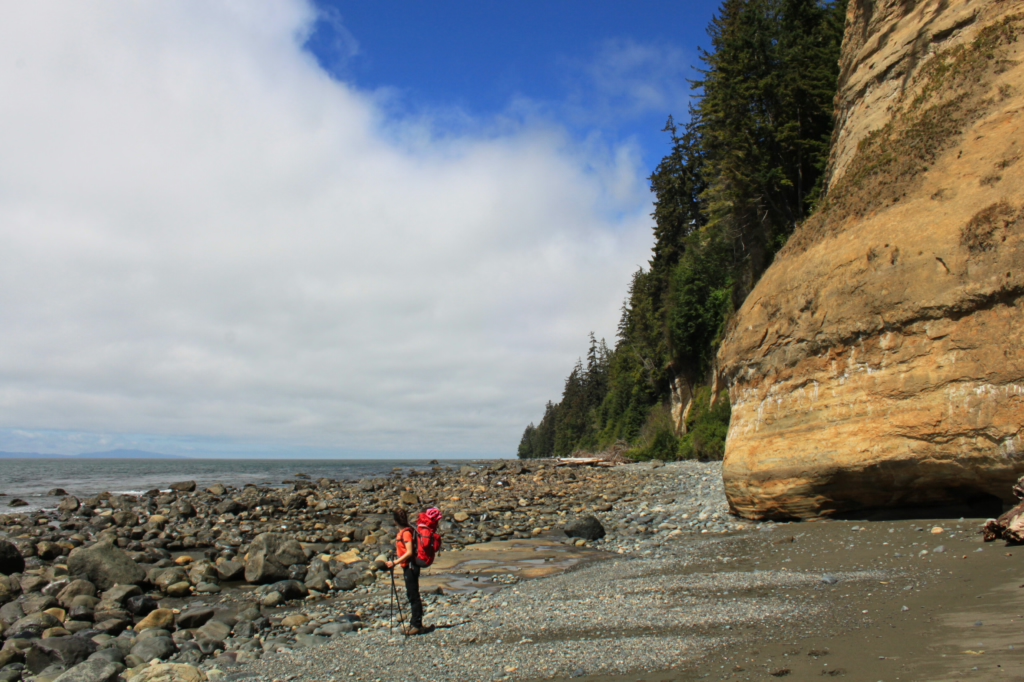
Juan de Fuca trail was the first multi-day hike I’ve done on Vancouver Island. I completed the hike in 3 days and was exhausted by the end of it.
Juan de Fuca trail is more difficult than the Cape Scott trail and slightly more crowded. But it’s also more accessible, as the trailhead is located just north of Sooke.
If you’re still unsure whether to hike Juan de Fuca Trail or Cape Scott Trail, check out my post.
5040 Peak

If you only have 1 day to hike on Vancouver Island, I highly recommend 5040 Peak. The trail to the top is steep but the views are absolutely breathtaking. I feel like I say this a lot about many of the hikes I do, but trust me this time. To some extent it reminded me of the Tin Hat Hut hike on Sunshine Coast.
If you also have some extra days on Vancouver Island, you could spend 3 days in Tofino or check out some of the stops between Nanaimo and Tofino.
What to Do After Hiking Cape Scott Trail
Since you’ve already driven so far north, I would recommend spending an extra day in North Vancouver Island. If you only have time for one activity, I personally think that should be kayaking.


After hiking Cape Scott trail we drove to Telegraph Cove where we went on a half day kayaking trip in the bay. If you have some extra time, you can even do an overnight trip. This is a very popular area to go whale watching and spot marine life. As such, I recommend reserving in advance so that you don’t miss out on anything.
Save it on Pinterest!


