
22 Best Backpacking Trips in BC and the Canadian Rockies
One of the main reasons I moved to Canada was the outdoors. I know it sounds crazy but once you try any of the backpacking trips below you’ll understand why. I personally hiked all the trails in this guide, which are focused on Vancouver, Vancouver Island and the Canadian Rockies.
For each trail, you’ll find the key stats, what to expect, permits and reservation details as well as tips for planning your trip. I’ve also included the trails I’d recommend if you’re just getting into backpacking.

This post contains affiliate links. If you make a purchase through one of these links, I may earn a small commission at no extra cost to you. It helps keep this site running and I only ever link to things I’d genuinely recommend.
Find Your Trip at a Glance

| Trail | Where | Distance (round trip) | Elevation Gain | Difficulty | Camping Permits |
|---|---|---|---|---|---|
| Elfin Lakes | Garibaldi Provincial Park | 22 km | 700 m | Moderate | yes |
| Frosty Mountain | Manning Park | 21 km | 1,150 m | Moderate | yes |
| Garibaldi Lake | Garibaldi Provincial Park | 19 km | 980 m | Moderate | yes |
| Lindeman Lake | Chilliwack Lake Provincial Park | 4 km | 230 m | Easy | backcountry registration |
| Cheakamus Lake | Garibaldi Provincial Park | 8 km | 280 m | Easy | yes |
| Russet Lake | Garibaldi Provincial Park | 30 km | 2,300 m | Moderate | yes |
| Semaphore Lakes | Pemberton | 6 km | 400 m | Easy | no |
| Wedgemount Lake | Garibaldi Provincial Park | 13 km | 1,300 m | Hard | yes |
| Howe Sound Crest | Cypress Provincial Park | 28 km | 2,519 | Hard | no |
| Golden Ears Summit | Golden Ears Provincial Park | 24 km | 1,700 m | Hard | yes |
| Mount Seymour | Seymour Provincial Park | 8 km | 580 m | Moderate | no |
| Joffre Lakes | Joffre Lakes Provincial Park | 9 km | 673 m | Moderate | yes |
| Tin Hat Hut | Sunshine Coast | 4-18 km | 300 - 962 m | Moderate | no |
| Mount MacFarlane | Chilliwack area | 18 km | 1,800 m | Hard | no |
| Flora Peak | Chilliwack Lake Provincial Park | 17 km | 1,700 m | Moderate | backcountry registration |
| Watersprite Lake | Squamish | 17 km | 710 m | Moderate | yes |
| Juan de Fuca Trail | Vancouver Island | 47 km | 1,500 m | Hard | backcountry registration |
| Cape Scott Trail | Vancouver Island | 49 km | 100 m | Moderate | backcountry registration |
| 5040 Peak | Vancouver Island | 8 km | 924 m | Moderate | no |
| Lake O'Hara | Yoho National Park | 22-30 km | 1,200 m | Moderate | yes |
| Berg Lake Trail | Mount Robson Provincial Park | 42 km | 800 m | Moderate | yes |
| The Rockwall Trail | Kootenay National Park | 54 km | 3,405 m | Hard | yes |
Before You Go on a Backpacking Trip
Hiking Essentials for Backpacking in BC & Canadian Rockies
In the Canadian backcountry, you should always carry bear spray and keep it within easy reach. On trails with unmaintained campgrounds, such as the Howe Sound Crest Trail or Upper Pierce Lake, you’ll also need a bear canister to store your food and other scented items.
Another item I never hike without is a pair of trekking poles. They make a noticeable difference on steep climbs and descents, especially when you’re carrying a heavy pack.
If you’re heading into remote areas like Cape Scott, it’s also worth bringing a satellite communicator, such as a Garmin inReach. It can be invaluable in an emergency when there’s no cell service.
10 Hiking Essentials
Before you hike any trail in BC and the Canadian Rockies, make sure you have the 10 Essentials.
1. Navigation tools
2. Headlamp
3. Sun protection
4. First aid
5. Knife
6. Fire-starter
7. Shelter
8. Extra food
9. Extra water
10. Extra clothing
Reservations and Permits: How it Works
Backcountry campgrounds in BC and the Canadian Rockies are accessible only by foot or boat. Most campsites have a tent pad, an outhouse and bear cache.
The main websites to book a backcountry campsite are BC Parks and Parks Canada, but not all campgrounds require a reservation. Some are free of charge and others only need a registration, such as Juan de Fuca trail. While a booking reservation allows you to select a specific campsite and night, a registration simply checks you in and requires a small camping fee.

Most provincial park backcountry campgrounds charge a nightly fee, $15 per person / night. If you’re visiting from outside BC, BC parks will charge an additional $20 per stay for non-BC residents.
Most of the BC camping reservations open at 7 am PT three months before your trip. But, there are a few exceptions. For example, reservations for the Berg Lake Trail are released all at once at the beginning of the year or December of the previous year.
If you didn’t manage to get a campground reservation, I always recommend checking back regularly or using tools like Campnab to get notified when a campsite becomes available.
For each of the trails below, I included additional information on campground reservations.
How Not to Get Lost in the Backcountry: Maps & Navigation
One of my best advises is to always have an offline map downloaded on your phone. I use Maps.me but AllTrails and Gaia GPS also offer offline maps.
Before any trip, check the trail status on either BC Parks, Parks Canada or Facebook groups. This is especially useful when the trailhead is at the end of a logging road. Access roads that require a high-clearance 4×4 can change significantly from year to year, so it’s worth checking current conditions before your trip.
Leave No Trace
The backcountry is so fragile and following the seven Leave No Trace principles helps protect the wilderness.
1. Plan ahead and prepare: if the trail requires a day-use access or permits research it beforehand
2. Walk on durable surfaces and use established tent pads
3. Pack out all your waste
4. Don’t bring home rocks, plants or other objects from their natural landscapes
5. Respect campfire bans and know that fires in most backcountry sites are not allowed
6. Respect wildlife, don’t feed or approach animals
7. Be considerate of others
Best Backpacking Trips near Vancouver
1. Watersprite Lake, Squamish

Watersprite Lake is one of the most rewarding overnight hikes near Squamish. The lake is located just outside Garibaldi Provincial Park and is maintained by BCMC.
Unlike most of the backpacking trips on this list, you’ll need a high clearance 4×4 vehicle to get to the Watersprite Lake trailhead. If you’re uncertain whether your car can make it up the final boulder, you can also walk the last section to the trailhead. Check out the latest Watersprite Lake road conditions before you go.
At Watersprite Lake you’ll find a backcountry cabin, tent pads and a stunning turquoise alpine lake.
2. Elfin Lakes Hike, Garibaldi Provincial Park

Elfin Lakes hike can be done as a day hike or multi-day backpacking trip. The hike starts from Diamond Head trailhead near Squamish and climbs gradually through the forest before reaching the top.
In summer you can camp on one of the 35 tent pads reservable at BC Parks. Alternatively, you can book a spot at Elfin Lakes hut. Both camping and hut permits are very popular and sell out fast.
If you have an Elfin Lakes camping reservation, you don’t need a separate day-use pass at Diamond Head trailhead.
3. Frosty Mountain, Manning Park

Manning Park is about 2.5 hrs drive from Vancouver. My favorite time to hike this trail is around end of September, when the larches on Frosty Mountain turn golden.
Keep in mind that nights can be very cold at this time of year. If you’d rather enjoy warmer weather, a summer backpacking trip is a great alternative. And if you can, experience both.
4. Garibaldi Lake, Garibaldi Provincial Park

Garibaldi Lake is one of the most popular backpacking trips near Vancouver and one of the most photographed lakes in BC.
Usually camping spots are booked out fast as soon as the reservation window open three months before your trip. But if Garibaldi Lake campground is full, you can book the less popular Taylor Meadows campground nearby.
Garibaldi Lake is also a great base if you want to hike to Panorama Ridge or Black Tusk. In this case, you can easily plan 2 to 3 days in Garibaldi Provincial Park.
5. Howe Sound Crest Trail, Cypress Provincial Park

The Howe Sound Crest Trail is one of the closest backpacking trips to Vancouver. But it’s not an easy trail as it has exposed sections and requires a lot of attention around certain areas.
There are no established campsites along the trail but the most popular spots are at Magnesia Meadows and Brunswick Lake. Check out the latest updates on Cypress Park website.
One of the most important things to know about the Howe Sound Crest trail is that you’ll need to either have a car at each of the trailheads or arrange for a pick-up at either ends.
6. Lindeman Lake, Chilliwack

Lindeman Lake is one of the easiest backpacking trips near Vancouver, making it an excellent choice for first-time backpackers. The hike is short and relatively straightforward, but its popularity means it can get busy on weekends.
If you prefer a quieter spot by the lake, continue on the trail to Greendrop Lake campsite.
7. Cheakamus Lake, Garibaldi Provincial Park

Cheakamus Lake trail is another beginner friendly backpacking trip near Whistler.
It’s surprisingly difficult to find backpacking trips in BC that don’t involve at least some scrambling. That’s why I always appreciate having a few easier trails to choose from. Ones where I don’t have to hike long distances or tackle technical terrain, but can still spend the night in the mountains.
8. Russet Lake, Garibaldi Provincial Park

Russet Lake is one of the easiest areas to access in the backcountry as the trail starts right from Whistler Village.
There are two main options to hike to Russet Lake. The most popular one is to take the Whistler Gondola and hike High Note Trail to Russet Lake. But I was into a longer hike and decided to hike via Singing Pass from Whistler Village and take the gondola (for free) on the way down.
If you don’t want to camp at Russet Lake, you can also book a spot at Kees and Claire Hut.
9. Semaphore Lakes, Pemberton

While most of the backpacking trips in BC require a reservation, Semaphore Lakes near Pemberton is an exception to the rule. The hike is short and the camping at all three lakes is free and first-come, first-served.
We decided to also summit Locomotive Mountain, but the trail to the top is not very well marked.
10. Wedgemount Lake, Garibaldi Provincial Park

Wedgemount Lake is located north of Whistler in Garibaldi Provincial Park. Not gonna lie, the climb is brutal, especially the last section to the top. But the moment Wedgemount Lake comes into view, every painful step makes sense.
The campsite has a few wooden tent pads, outhouses and bear hangs.
11. Golden Ears Summit, Golden Ears Park

Don’t confuse this trail with Panorama Ridge in Garibaldi Provincial Park. In fact, this hike is located in Golden Ears Provincial Park and is one of the hardest backpacking trips I’ve done.
Expect some scrambling closer to the top and steep sections. On the ridge, the campground has 10 campsites: four tent pads and six additional established sleeping areas.
Golden Ears offers some of my favorite views in BC, overlooking Pitt Lake and stretching all the way to Mount Baker on a clear day.
12. Mount Seymour, North Shore

Mount Seymour is one of the closest places you can go on a backcountry trip near Vancouver. You can camp overnight past Brockton Point while enjoying the Vancouver skyline from the top of the mountain.
If you’re doing a backpacking trip to Mount Seymour, don’t forget to reserve a free day-use pass and park in Lot 1.
13. Joffre Lakes, Pemberton

Joffre Lakes is one of the most popular hikes in BC. While it has the striking turquoise colours of the lakes in the Canadian Rockies (see Moraine Lake or Lake Louise), it’s not as far from Vancouver.
The Joffre Lakes campground is located at the Upper Lake and has 26 campsites you can book at BC Parks. This is one of the hardest places to book in summer due to its popularity.
If you didn’t manage to reserve a site check back regularly or sign up with Campnab to be notified when someone cancels a spot.
14. Tin Hat Hut, Sunshine Coast

Tin Hat Hut has some of the most scenic views in BC. It is located at the midpoint of the hut to hut Sunshine Coast trail but many do it as a standalone hike.
Tin Hat Hut is open year round and you can sleep in the hut both in summer and in winter. On weekends though, the hut gets crowded so your best option is to find a flat surface to camp outside.
15. Mount MacFarlane (Pierce Lake), Chilliwack

Mount MacFarlane hike was by far one of the hardest backpacking trip I’ve done in BC. The first section of the trail to Pierce Lake is very steep and the extra weight from the backpack makes it even harder.
We camped at the Lower Pierce Lake and continued to the summit the next day. Many hikers though camp at the Upper Pierce Lake instead. Note that there are no wooden tent pads and there is no bear cache to store your food. So come prepared.
16. Flora Peak, Chilliwack

I often hear people talking about hiking to Garibaldi Lake but very few know about Flora Peak in Chilliwack. Not only does Flora Peak pair well with a Lindeman Lake or Greendrop Lake hike, but the summit has some of the most panoramic views of Chilliwack Lake and surrounding mountains.
We camped at Flora Lake for the convenience of having water access but if you can also stay overnight at Flora Peak. The difference is that Flora Lake has 2 wooden platforms for the tents, while Flora Peak is more exposed and has no water source or wooden pads.
Best Backpacking Trips on Vancouver Island
17. Juan de Fuca Trail, South Vancouver Island
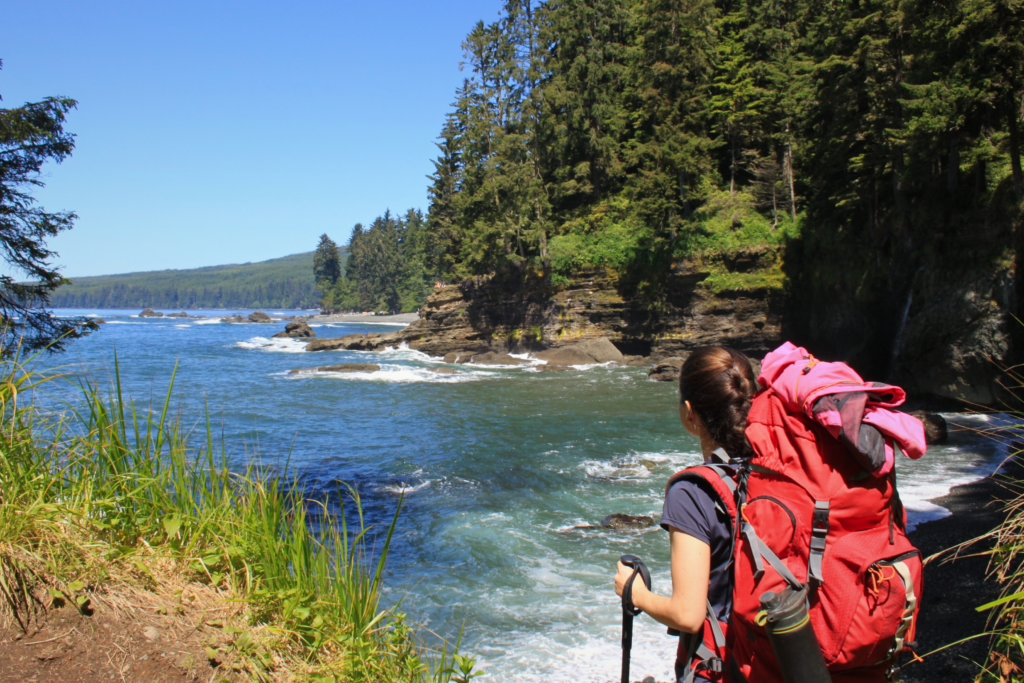
Juan de Fuca trail was my first multi-day backpacking trip in BC. The trail follows the coast on Vancouver Island and contrary to the more famous West Coast Trail in Pacific Rim National Park, it does not require advance reservation.
My guide on how to hike Juan de Fuca in 3 days has all the information you need!
18. Cape Scott Trail, North Vancouver Island

The Cape Scott Trail is a remote backpacking trip in the north of Vancouver Island. It’s not as crowded as other hikes in BC but the scenery is unbeatable.
What differentiates this hike from the others is the wildlife sightings. On our trip, we spotted several black bears as well as sea wolves roaming on the beach in front of the campsite.
Cape Scott Trail is often compared to Juan de Fuca Trail. While both are incredible backpacking trips, they are also very different. Read more about the comparison of Juan de Fuca vs Cape Scott trail in my guide.
19. 5040 Peak, near Tofino
5040 Peak hike is relatively short but very rewarding. The summit has some of the most stunning views of Vancouver Island.
Since 5040 Peak is located outside Strathcona Provincial Park, no permits are required to camp here. But if you decide to book a spot at 5040 Peak Hut, it costs $150 per room (6 people total).
The trailhead is located an hour from Tofino, making it a perfect addition to a 3 day trip to Tofino.
Best Backpacking Trips in the Canadian Rockies
20. Berg Lake Trail, Mount Robson Provincial Park

Berg Lake Trail is one of the hardest multi-day hikes in the Canadian Rockies to get a permit for. But it’s for a good reason. Not only do you get to hike and camp to the bottom of the tallest mountain in the Canadian Rockies, Mount Robson, but you also experience one of the most beautiful trails in BC.
Getting a Berg Lake Trail permit is not easy and very competitive. For the 2026 season, the reservations opened on December 2, 2025. I would recommend adding the date in your calendar so that you don’t miss it.
Along Berg Lake Trail there are seven campsites you can book but the most popular one is Berg Lake campground.
21. Lake O’Hara, Yoho National Park

Lake O’Hara in Yoho National Park is one of the hardest campgrounds to reserve. Access to the lake is only possible on foot along the 11 km access road or via the reservable shuttle bus. The shuttle bus reservations are offered through a lottery system, which are often hard to get.
The campground has 30 sites and reservations open in February all at once for the entire summer season. If you were not able to secure a spot, check back regularly or use Campnab for any cancellations.
22. The Rockwall Trail, Kootenay National Park

The Rockwall Trail is one of the hardest backpacking trips I’ve done in Canada. Over three days, we crossed 3 mountain passes, with constant elevation gain along the route. The landscape though is one of the best you’ll experience in the Canadian Rockies.
There are a total of 5 backcountry campgrounds along the Rockwall Trail, but the most famous one is at Floe Lake. This is also the most difficult one to secure, so prioritize reserving the Floe Lake campground as soon as the reservations open up, which is usually around end of January.
My favorite viewpoint on the Rockwall Trail was at Numa Pass, where you can admire the entire Rockwall as well as Floe Lake in the distance.
What to Bring on Backpacking Trips in BC
Backpacking is not for everyone and one of the main reasons is the amount of gear you need to carry to reach your campsite. If you’re just getting started, buy used gear and only start upgrading if you find that you enjoy backcountry camping.
The main items you’ll need are a tent, a sleeping bag and a sleeping pad. If you plan on staying at a hut, such as Kees and Claire Hut or 5040 Peak Alpine Hut, you won’t need to bring a tent.
Next, you’ll need a stove, fuel, a pot and cutlery for cooking. You should also always carry a water filter to purify your drinking water. Although the water may look clear, you never know what bacteria or other microorganisms could be in it.
For clothing, dress in layers. Start with moisture-wicking base layers, add a fleece or down jacket for insulation and finish with a waterproof shell. Be sure to pack warm layers for the evening, as temperatures can drop sharply once the sun goes down.
On longer backpacking trips, I prefer hiking boots over hiking shoes because they provide better ankle support. If you prefer hiking shoes, make sure the trail isn’t extremely muddy. If it is, pack a pair of gaiters.
Always carry the 10 Essentials for safety and navigation, along with bear spray and a bear canister where appropriate.
My overall advice is to pack lighter than you think you need. The biggest difference in price between camping gear often comes down to weight. The lighter the gear, the more expensive it tends to be.
Final Thoughts
Once you get into backpacking there is no looking back. I’ve personally experienced backpacking trips in Peru and other parts of the world, but BC and the Canadian Rockies are some of the best backpacking destinations I’ve been to.
If you’re new to backpacking, start with easier trips, such as Lindeman Lake, Semaphore Lakes or Mount Seymour. Once you get more comfortable at it, try longer trails such as Berg Lake or Juan de Fuca Trail.
If you’ve been on any other backpacking trip that is not covered in this guide, drop a comment below.
FAQ Backpacking Trips in BC & Canadian Rockies
1. Do I need a permit to backpack in BC & Canadian Rockies?
It depends. Many popular national parks and provincial parks require you to book a camping permit. This can be done at BC Parks or Parks Canada. Some other areas, only require a backcountry registration, which doesn’t guarantee a campsite but requires you to pay a fee. A few others are completely free.
2. How far in advance can I book BC backcountry campsites?
The majority of the BC campsites can be booked 3 months before your trip. Some though, such as Berg Lake, open at the beginning of the year for the entire season.
3. How much does backcountry camping cost in BC?
BC Parks charges $25 per person / night and a $6 reservation fee. But starting 2026, a $20 non-resident fee applies to anyone visiting BC from abroad.
4. What is the difference between a reservation and a registration in BC Parks?
A reservation guarantees a campsite while a reservation registers your presence in the backcountry and requires you to pay a fee.
5. What is a BC Parks day-use pass and when do I need one?
If you’re doing a day hike to Garibaldi Provincial Park, Joffre Lakes or Golden Ears you’ll need a day-use pass for your vehicle on specific days during the summer months. Check the details on BC Parks.
6. How hard is it to get a Lake O’Hara reservation?
Due to the increased popularity, in recent years a Lake O’Hara lottery reservation system has been introduced. It’s a matter of luck and good timing and securing a Lake O’Hara reservation is one of the hardest permits to get in the Canadian Rockies.
7. What is the best time to backpack in the Canadian Rockies?
July and August are the best months for backpacking in the Canadian Rockies. Although weather becomes more uncertain and chances of snow are higher, September is a great time for the fall foliage and larch hikes.


